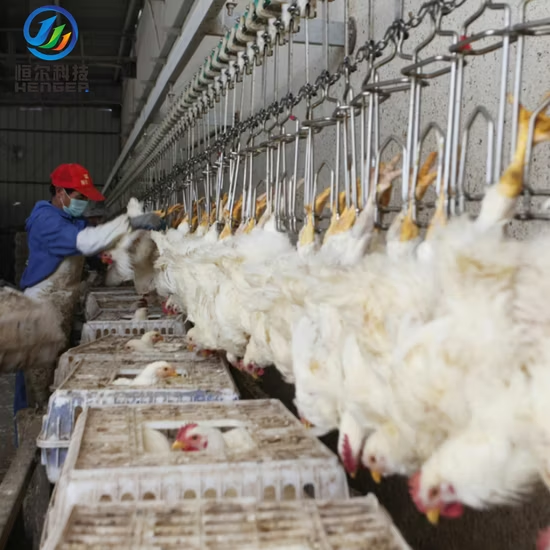
The wrong size chicken for the slaughter line
I was interviewed today by researchers from Åhus university as part of a study on diversification in danish organic agriculture. Towards the end of the discussion, the question came up about the barriers to a more diverse, more holistic, perhaps more humane animal production.
I’ve heard this question before and I’m always curious about the assumptions that lie behind it. Researchers often like a concrete problem that can be solved with a simple policy intervention: easier access to financing, fewer regulations, better advice – that kind of thing. But we don’t often get to talk about the underlying structural conditions, or the consequences of previous decisions that restrict our options in the present.
I asked for examples, and the researcher explained that the biggest barrier to a more diverse and humane chicken production is that the chicken killing machine only fits one sized chicken. The organic chickens – which grow up in different sizes – don’t fit. So it is therefore hard to produce more organic chickens.
This seems to be a very accurate metaphor for our current relationship with technology.
Our conversation ended there. I wondered if the chicken farmer also stopped his interest in more humane chicken farming here. ‘Sorry chickens, that’s how it is’.
But i also wondered if there was another possibility. Surly there is a way to put together the constellation of relationships that link chickens, eggs, landscape, livelihood and money that isn’t dictated by the mechanical slaughter line?