“The journey is the destination” – Dan Eldon
Vera Maeder is half of the artist duo behind Hello!Earth, a good friend and a huge inspiration. Vera and her partner Jacob describe their work in terms of ‘quests’.
It’s a great word in English that is hard to translate into Danish. A quest is combination between a journey and a question. Think of the Quest for the Holy Grail, The Wizard of Oz, The Hobbit … the point of a good quest is less about the destination, but about the journey and the relationships built on the way.
Vera and Jacob’s quests last for years and include different artistic and research practices. They did a series on ‘the night’. How do different perspectives and ideas that appear after dark? Or when we sleep? They worked on ‘rest’. How do we re-imagine the role and meaning of rest in our hyper-scaled, non-stop society?
Quests are great because even though they have a protagonist, they are also collective. There are always companions and collaborators who may or may not have their own interests but will contribute to the exploration of the journey / question. Quests can take unexpected directions, go off on tangents, and perhaps end in a place that wasn’t planned at all.
Some of these companions and collaborators might not be human. In the stories they are often fantasy creatures like wizards and dragons. In our world they can be other species, animals, plants or historical figures.
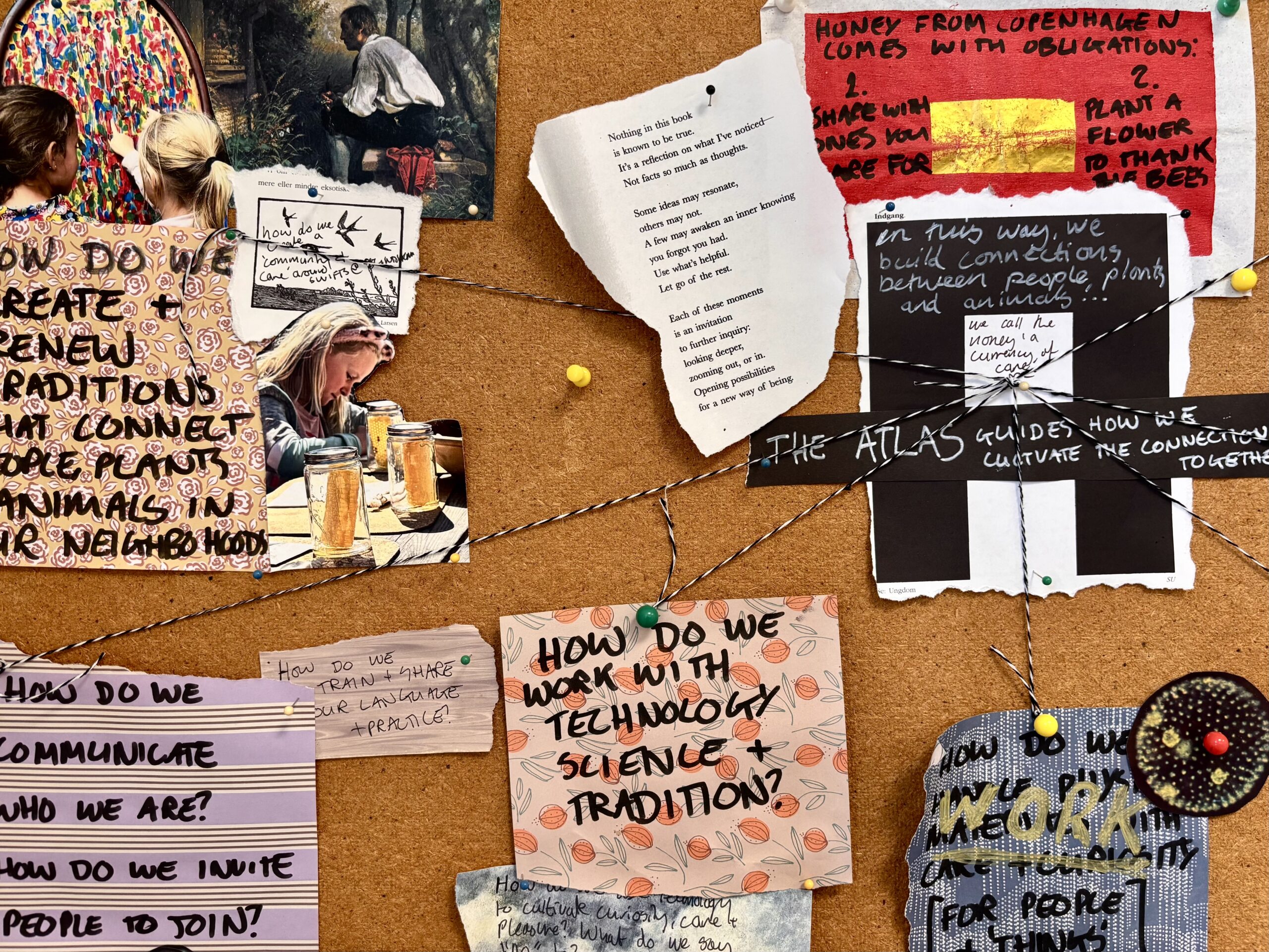
At Bybi we like to think of our work in terms of quests too. The idea for this website emerged as a quest: How do we turn consumers into co-creators? What happens when honey is no longer a ‘product’, but an ‘invitation’?
It also has implications for how we think of leadership and management. We’re not interested in traditional hierarchies, but we are interested in an alignment of quests.
These days, especially for younger people, the question “what will you become” collides with the risk that most jobs that you can train for won’t be around much longer. Our education system is training people for jobs that won’t exist. As employers – and as parents- what do we tell our children and young colleagues?
A good quest can be an answer to this question. A quest is about community-building and curiosity. It is about relationships. It is about self-responsibility. It is about world-making. A quest might be “How do we bring eels back to this degraded river system?”, “how do we recover the lost art of basket-weaving?” or even “how do we revive cabbages in the Danish society and economy?”. This last one is fascinating – something that the brilliant Aiah Noack has been looking into at Naturplanteskolen.
You don’t need a job for a quest. You need curiosity, time and the confidence to stitch together improbable collaborations. Of course, you also need money. But that raises another ‘quest’ to explore together. It is a difficult one when the need is urgent and being poor means carrying the weight of institutional violence and social expectations. How do we bring money into these kinds of constellations?